Tuesday, 16 October 2018

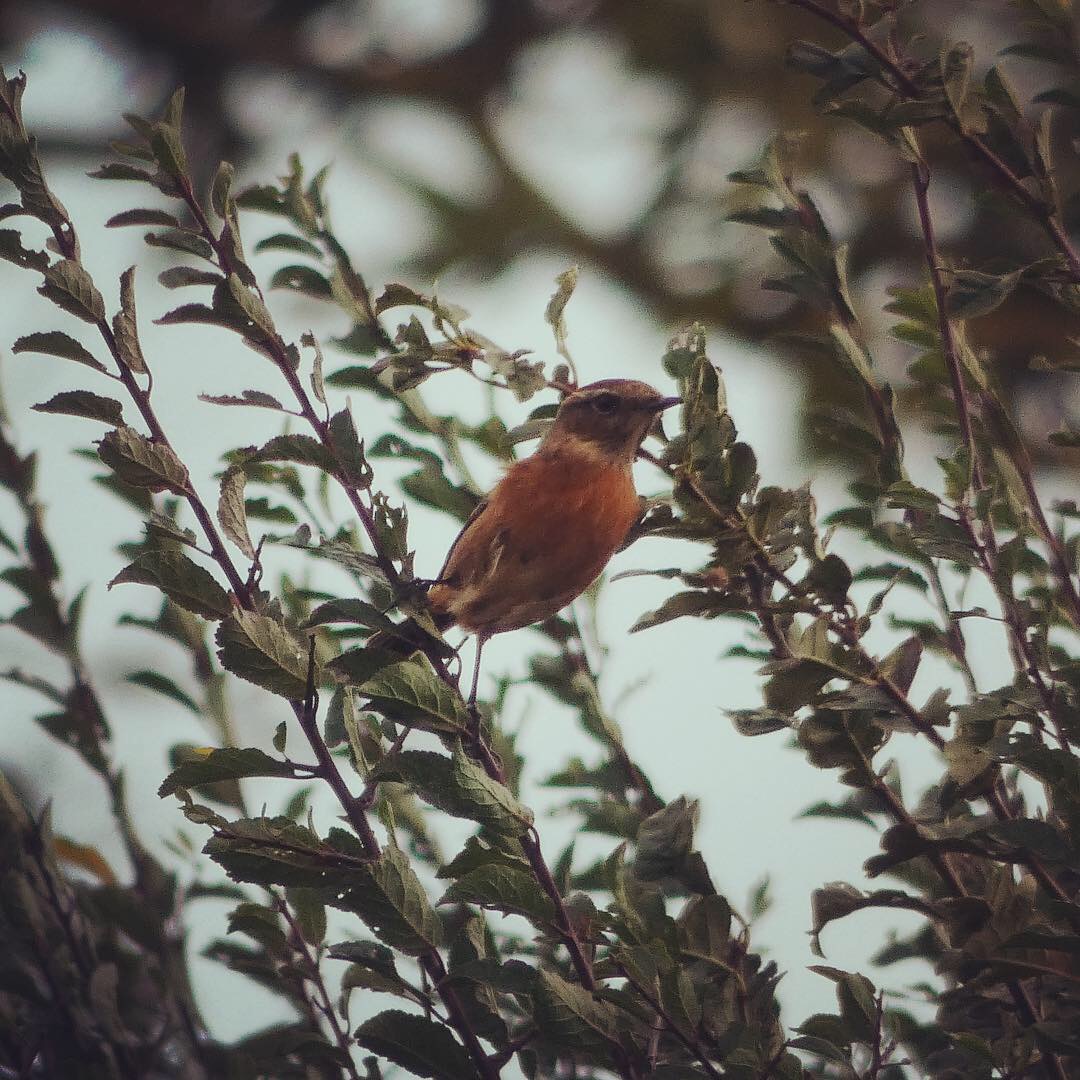
Stonechat makes it 138


A very mixed selection of weather from the back end of Storm Callum made birding difficult over the weekend. With heavy rain & wind on Saturday morning I held back my visit with Mrs D until late morning. With Stonechat still not on patch year list we decided to walk the patch perimeter where there are more variations in habitat. 

A couple of Redwing flew over as we headed through Dunnington Court Farm where as usual there were huge flocks of Red-legged Partridges & Pheasants. It won't be long until the large flocks of winter thrushes will be back in this area. Grey Heron, Mallard, Linnets & Yellowhammers were recorded on the way to Ennister Wood. Sadly no movement on any of the Tree Sparrow boxes installed by Ragley.

As we walked towards the gate a small bird flitted up flying like a Stonechat then flew straight across the field. My eyes were firmly fixed on the location so we retraced our steps to this central strip of rough land between the fields. After a short wait the Stonechat emerged swinging in the wind, becoming our 138th species of the year. Trying to use the camera was very difficult but did get a few shots. 

The walk along the railway line & river only returned a large flock of Long-tailed Tits, a Treecreeper, Nuthatch & Goldcrests. I do really like this area and is close to where last year Yellow-browed Warbler was found. 

Heading over the A46 bridge the Pophills Common Buzzard was drinking on the river bank. As we reached the gate and looked towards the barn a Wheatear was perched on one of the tree stakes. This absolute stunner showed very well for about 20/30 minutes when it was flushed by the local shoot who started late due to the rain. Always happy to find a Wheatear. We didn't even check the main pit due to the shoot now spreading everywhere.

Heavy rain was the issue on Sunday and it didn't stop during the duration of mine of Jon's count. There was no movement at all as it has rained from late Saturday night. The weather was rank bad. 

Our meagre counts included 28 Little Grebe, 85 Cormorant, 6 Grey Heron, 13 Mute Swan, 425 Greylag, 2 Canada geese, 6 Wigeon, 5 Gadwall, 42 Teal, 160 Mallard, 1 female Pochard, 38 Tufted Duck, 2 Kestrel, 1 Water Rail, 144 Coot, 3 Snipe, 1 Herring Gull, 1 Grey Wagatail, 6 Redwing, 6 Chiffchaff, pair of Ravens and a Redpoll.

Monday, 8 October 2018

Marsh Tit finally added

Meadow Pipits still coming through in good numbers
Autumn leaves
Two Pintails (Monday)
Very still man in pit
Marsh Tit 
Marsh Tit became our 137th species recorded this year, we are now four away from the record. Grey Partridge & Stonechat are our on the top of our list to find but are proving rather difficult. 

Nothing of real note to blog about so I'll just record the best counts for each species taken over the week.

29 Little Grebe, 13 Mute Swan, 550 Greylag (Site record), 22 Canada Geese, 12 Gadwall, 57 Teal, 230 Mallard, 5 Shoveler,  Sparrowhawk, 8 Buzzard, juvenile Hobby (observed twice), 3 Snipe, Water Rail, Greenshank briefly, third winter Yellow-legged Gull, 3 Grey Wagtail, 1 Swallow, 60 Redwings, 1 Reed Warbler, 2 Pintail,  7 Wigeon, 4 Green Sandpiper, 75 Cormorant, 23 Common Gull, Red Kite, 1/2 Peregrine Nuthatch (Ennister Wood, Kingfisher (Wixford), Blackcap, Reed Warbler, 3 Chiffchaff, 10 Goldcrest, 60 Skylark, 150 Meadow Pipit, Marsh Tit, 5 Jays, 3 Raven, 40 Greenfinch, 160 Linnet & a Siskin. 

Thanks to Jon, Chris, Paul & Mark for their sighting contributions.

Monday, 1 October 2018

Pits welcomes new visitors

Peregrine recharging energy after another failed hunt
Red Kite
Around 200 Starlings present currently
Cormorant Tree
Main Pit (east side)
Always plenty to see when reaching the main pit

Visits on Friday, Sunday & Monday to the pits recorded pretty similar sighting still lacking any wader movement. On Sunday Jon, Chris & myself hosted Roger Broadbent (Chairman of West Midland Bird Club), Jim Winsper (West Midland Bird Club long term contact) & the new Warwickshire recorder Chris Hill. Two Red Kites past over the car as we went through Dunnington.

A Sparrowhawk flew over Roger's car as he pulled up and we headed round for a full tour of the site. It was interesting to note new visitors thoughts on the site and the current restrictions with access and no management. A pair of Mandarins flew over that looked like they could land on the main pit but sadly they kept going. A few more signtings of this species in recent weeks is encourgaing. We are still trying desperatly to find the overdue Stonechat & Marsh Tit for the site year list.

A male & female Peregrine started the session well, whilst the male hung around all morning trying a varied type of attacks including trying to take down a flying Cormorant. At the main pit, a Water Rail was creeping around under the willows, whilst other counts uncluded 390 Greylag, 5 Wigeon, 70 Lapwing & 3 Swallows.

Two Green Sandpipers flew out from the drainage ditch which also contain many Meadow Pipits. Sadly the Old Workings was quiet except a Grey Heron & the regular Stock Doves. 

The Cormorant count contines to rise with 56 being present on their regular old tree above the south lagoons. We are hoping the Manadrin or Sandpiper could have been down here but all very quiet except a flyover by one of the previously seen Red Kites.

More Skylarks and Pipits were on the meadow as we headed back north past the central lagoon befoe ending back at the main pit where 4 Jays flew over very high heading south. There certianly seems to be a influx this Autumn.

It was a pleasure to welcome both Roger & Chris to the site for the morning. All of the team really enjoyed their company and it excellent to understand their very committed roles. The roles these guys do benefit us all and can not be underestimated.

Grimley Cattle Egret & Stonechat

Cattle Egret
Flight shot
Egret grabbing insects from where Cattle had been walking
Nice size comparison
Cheeky Stonechat
All three in shot
Arty shot
Perched up
Early morning on the causeway
Riverside
Opted for a change of scenery on Saturday as both Mrs D and I fancied a decent walk with some nice habitat. After weighing up a few options we headed to Grimley. To be honest, on all previous visits I have only really visited the Camp Lane pit or the Wagaon Wheel pits and not explored anywhere else. 

The cold temperature of night had caused a blanket of fog so it took a while for it to lift into the stunning day it actually became.  With the fog making viewing difficult we headed east towards the river. To the field just off the lane I found two Stonechats flying around catching insects off the top of the reeds. 

After checking the Wagon Wheel pits we followed a tip by local birder "Patch" to where the recently seen Cattle Egret had been seen. Sadly no luck here except a Buzzard sat perched picked out by Mrs D. We then headed south along the river where the walking was stunning. More Buzzards, Kestrel & three Mistle Thrushes were all noted. I'd certainly do this walk again as it was a real unexpected surprise. 

Patch then text us saying the Great White Egret earlier seen was back on the main pit but quickly moved off again before we arrived. On the plus side the Stonechat had now risen to three and were showing very well.

After a recharge for lunch I was determined to see the Cattle Egret that was finally found in the Wagon Wheel Cattle field.  Only downside the field of cows included a sizeable Bull that looked like it was chewing a bumble bee. I duly kept my distance as I tried to take some record images. Cattle Egret are the latest species to colonise after Little Egret, Great White Egret & Spoonbills. There was a influx in the winter of 2007/8 which led to the first youngster being raised in Somerset in 2008.


As I left there was a female Goldeneye on the same pit which was a nice addition to round up an excellent days birding.

Monday, 24 September 2018

West Midlands record Grey Phalarope haul for Salford Priors

Fridays new arrival
Grey Phalarope - No.136 on the pits year list
Amazing detail on birds back

Poorly light on Saturday
Profile shot
Wheatear
After the Sunday storms
Sunday action shot
Meadow Pipit
Large flocks of Martins still passing through (M Clarke)
Peregrine (M Clarke)
Spot on Arctic wader here on Pophills
Common Sandpiper


With a number of Grey Phalarope being blown in with very strong westerlie winds I was hopeful that we might get one at the pits. With an extented weekend off work I headed down on Friday morning determined to find one. Starting at Kingley pool then working south I checked all lagoons before finally ending up at the main pit. 

There in front of me at the south end of the main pit was the expected juvenile Grey Phalarope, as I text the rest of the team I then picked out a second Pharalope. The birds were constantly feeding and appeared very comfortable in their new surroundings. There had only been one previous record at the pits in September 2010, so to record two was  unique.

With the light being excellent I managed to take some video and still images of the birds. With no contractors working it enabled many people to come down and see the birds over the weekend. Other Friday sightings included a Hobby, 2 Common Sandpiper, 1 Golden Plover, Great Crested Grebe, 15 Sand Martin, 12 Swallow, 40 House Martin, Raven, Pintail, 90 Meadow Pipits & 60 Skylark.

Knowing more people wanted to visit on Saturday I went very early on the hope the birds were still present. Starting at Pophills as I do normally, I wanted to check check the east shoreline for waders and after picking up the Common Sandpiper there was another Grey Phalarope. Surely it must be one of birds from the main pit, but no, the plumage looked more advanced. The Squire arrived and we were both agreed different bird but was the pair still on the main pit ? They were indeed making it a record count for the West Midlands region, thanks to Phil Andrews for this information. This seemed to generate more interest and we had a steady stream of visitors for the rest of the weekend all following the direction and behaving perfectly. Mike Wakeman text me on Friday as he wanted to head down but some how eneded on Pophills rather than the main pit and he observed a Pharalope early on Friday evening so this must have came in early afternoon.

These amazing tiny birds breed high up in the arctic ;north siberia, Canada, Siberia, Alaska & Greenland and are migrating south to South Africa. You will notice from the video the birds spin when feeding to stir up food, normally clockwise.

Further Saturday sightings included 2 Wheatear, 103 Meadow Pipits, 7 Wigeon, 90 Lapwing, a Swallow, 60 House Martin, 11 Golden Plover & 2 Great Crested Grebe.

So, on to Sunday where it was lashing down with rain for most of mine and Jon's normal session. Two Phalaropes were present on the main pit but no sign on Pophills. We both observed a wader twice that we both through was a Pectoral Sandpiper but with the rain and optics struggling with conditions we couldn't refind the bird despite our best efforts. Very frustrating.

Other Sunday highlights included a juvenile Peregrine hunting the wildfowl on main it, attempted repeated attempts before landing by the Little Owl tree, 21 Golden Plover, Green Sandpiper (Old Works lagoon), Kestrel, 150 Swallow, 18 Sand Martin, 130 House Martin, 6 Wigeon,  1 Pochard (central lagoon), 30 Siskin & 3 Reed Warbler. 

Monday update :- Both birds still present

Wednesday, 19 September 2018

Hampshire bound for Ortolan Bunting

Ortolan Bunting
Ortolan Bunting
Portsdown Hill
Ortolan Bunting
Ortolan Bunting
Waders scrape
Farlington Marsh
Redshank


Since my interest widened to see rarer birds that visit the UK the opportunity to see an Ortolan Bunting has been minimal or none. It's propably no concidence that the population in Europe has dropped by 84% since 1980. It's reported 30,000 are trapped every Autumn when the species migrate from eastern europe over France to west Africa.

On Friday, news emerged that a bunting had settled on the downs above Portsmouth in Hampshire. I kept half an eye on the sightings and as day continued the sightings became even more regular. In all honestly I thought the bird would probably move on overnight but I was pleasantly surprised to see an earlt report on Twitter on Saturday morning with a photo. This was good enough for me to punch the postcode in the Satnav & head south.

The good thing about heading that way is that it's all motorway or dual carridgeway making it a very smooth drive. I opted away from the reported lane and walk the ten minutes back to Pigeon House Lane. I passed plenty of happy birders on the way down the lane despite the lack on reports on RBA.

As I set my scope up the locals were very friendly pointing out where the bird had been favouring. A very patient forty minutes was tough going with only a Buzzard, Chiffchaff, Blackcap & two House Martins to view.

The bunting was appartently feeding low in the stubble although it was doing a good job of staying that way. Then as per the locals forcast the Ortolan duly flew on top of the hawthorn bush that was full of berries making it a very pretty sight. The bird was larger than I expected but sat very still enabling me to scope it well to see the birds features. I even managed to take few nice shots that I was pleased with given the distance. 

From here I headed to nearby Farlington Marsh where I had not visited before. Plenty of waders including Redshank, Black-tailed Godwits & Dunlin on view in some stunning sunshine before I headed back to Feckenham for the last cricket game of the season that saw the Millers reach the Worcestershire Premier League next season.

Autumn movements at Salford Priors

Can't beat a Wheatear on your patch
Wheatear
Greater Spotted Woodpecker
Ruff
Greylag flock
Pophills early
Two visits to the pits at the weekend with first being when I returned from Hampshire. The best bird discovered was a female Ruff feeding on one of the central islands.

On Sunday John & I did a comprehensive check on the whole site. A Common Sandpiper was on Pophills before crossing over to the main pit. Whilst the Ruff has moved on a Dunlin had arrived and the wildfowl included a drake Pintail, 12 Wigeon & 23 Shoveler. Also recorded was 2 Snipe and a flock of 300 House Martin & a single Sand Martin. When we were on the south lagoons the first of two Golden Plover circled above and continued to do so. A true sign we have reached Autumn. 

Three Wheatear were showing very well in the Old Workings, a species I never tire of. Late morning a Greenshank went through high, another 80 House Martins, a Grey Wagtail, Peregrine & 80 Meadow Pipits.