Saturday, 10 February 2018

Halesowen Hawfinch's breaks midland record


I woke on Saturday and was surprised the forecasted heavy rain hadn't arrived so I decided to head over to Halesowen Cricket Club to look for the midland record breaking flock of 65 Hawfinches. 

After parking up I headed down the path before carrying on through the underpass to Seth Somers Park. On the path I met the local patch watcher (Todd) who found the first two birds last Sunday. There were around half a dozen friendly birders present throughout the morning enjoying the birds. 

Its hard to believe that these giant finches are normally birds that you have to work really hard to get on your year list, this winters explosion has been brilliant on whats been a very poor winter for birds. I managed a count of 40 birds and picked up another two in a different spot.

The birds were in all fairness fairly distant except a few individuals but I'd never seen flocks of Hawfinches in flight before. The only downside of the morning was the very poor light making any photos very difficult.

Well done to Halesowen Cricket Club who offered free parking and welcomed all visitors into their clubhouse for hot drinks & some very tasty,big breakfasts.

Bartley Reservoir Gulling


Iceland Gull (taken last year)


With a shocking forecast for Saturday I opted to call in to Bartley Reservoir on the way home from work on Friday to catch the Gull Roost incase I couldn't get out on Saturday. There has been over 35,000 Black heads coming in recently however this roost was on the quieter side sadly.

I picked up four Goldeneye whilst I was waiting for gulls & there were at least 7 Great Crested Grebes & 5 Grey Herons at the east end. I'd just got my eye in and located the 2nd winter Iceland & 3 Great Black-backed when the local Peregrine decided to ruin the party. I saw the raptor arrive from over the school and head straight for the middle of the roost. Speaking to top midland guller Terry Hinnet he advised that one of the gulls may have been carrying a loose bit of fishing line or rubbish attracting the Peregrine as an easy target. 

It is always great to see a Peregrine but I'd rather this individual have saved this particular visit, he tried four different runs at the roost causing the gulls to perform their own type of murmuration. As the light faded I headed for home as I didn't fancy taking any risks being on my own in a well known trouble hot spot.

Sunday, 4 February 2018

Corn Buntings high & handsome

Corn Bunts to east of the pits
Nice views with patience
Strong beak confirmed distant views
Fieldfares
Yellowhammer flock
Returning Oystercather
Reed Bunting
Five of the six Sheldick
Green Sandpipers
 Peregrine keeping low profile
Same bird opting for different view
 Shoveler numbers continue to increase
 Who needs Slimbridge
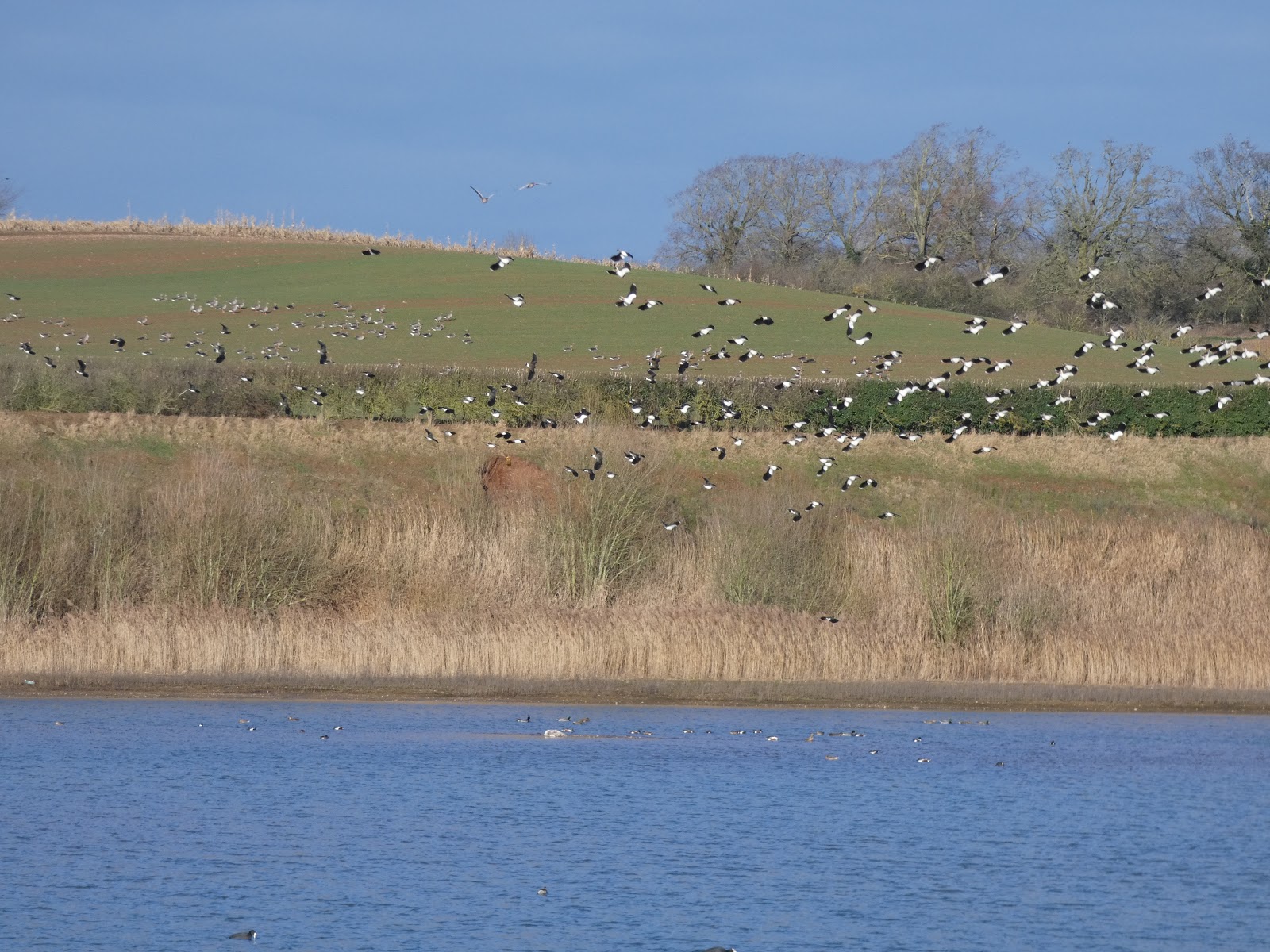
Lapwings over head

It's been a pretty good week down at the pits with an interesting variation of species. On a really positive note four Corn Buntings were found in the same area as last year which indicates they successfully bred last year. Within the same area there were 60 Yellowhammers & 15 Skylarks. 

Down at the local farm where I undertake audits for the farmer there were 16 Skylarks singing, 9 Meadow Pipits, 20+ Fieldfare, whilst there were some nice mixed groups of Chaffinch, Reed Bunting, Linnet & a couple of Bullfinch for good measure.

At the main pit the Oystercatcher returned to his spiritual home whilst the Shelduck numbers increased to six. Other sightings included maximum counts of 3 Wigeon, 11 Gadwall, 38 Tufted Ducks, 39 Shoveler (new record), 80 Teal, 23 Cormorant, 120 Lapwing, 5 Skylark, 3 Mute Swans, 35 Black-headed Gulls, 220 Canada Geese & 350 Greylag. 2 Siskin were in the plantation on Sunday.

The 3 Green & the Common Sandpiper remain on Pophills but do occasionally head over to the main pit. Chris also recorded a single Redpoll in the hedge midweek.

Raptor sightings have been restricted to a Peregrine, 4 Common Buzzards & 2 Sparrowhawks. We have now reached 78 species for the year.

Aust Warth Super Shorties

Shortie flypast
Silhouette
Wingspan
Hunting closer
A fantastic location

Our final stop on a great days birding would be Aust Wath in South Gloucestershire. A well known spot for over wintering Short-eared Owls, its just a gamble whether they are out flying. We didn't have to worry for long as two were out hunting the salt marsh as we pulled up. The rough grassland is perfect for these mole hunting predators. Their long wings for botany flight always make them appear larger than they actually are.

At one stage there were three birds hunting at the same time before a battle commenced between one of the Owls and a Kestrel over a captured mole. The birds tussled and fought at an increasing height. The birds reached an amazing height before the Kestrel finally took the prize. 

Short-eared Owls are always a winter treat whilst we wait for spring to reach us. 

Now that's a Duck !


The chance to see a drake Long-tailed Duck at close quarters is always worth taking. So rather than head up the M5 we took the scenic route to Barrow Gurney. Thanks to a great parking tip from local Brian Thompson we parked right next to the Reservoir Number 1 tank. 

The stunning sea duck could be seen immediately in the company of the local Tufties. Apparently bird has been around the area since November spending time on the other tanks as well as visiting nearby Blagdon Lake & Chew Reservoir. 

Around the edge of the reservoir there were 10 Common Gulls & 25 Black-headed Gulls.

Ham Wall winter feast

Ferruginous Duck
Following the Pochards
Great White Egret
Pintail
Bitterm (Back end only)
Marsh Harrier
Kingfisher
The Tor
Little Egrets

I teamed up with Chris Lane for a trip down to the RSPB Ham Wall to enjoy their seasonal feast of delights. Ham Wall is 2.5 miles west of Glastonbury in the valley of the River Brue or better known as the Somerset Levels.

Ham Wall is a nature reserve of the highest quality and is made up of rustling reed beds and glinting open water. The Starling roosts of over 750,000 birds are the star attraction for many visitors however we planned a busy day staring early.

The car park has improved considerably since I first visited a number of years ago & the toilets were a welcome sight to visitors of a certain age.

Our first star species was a Glossy Ibis that I picked up flying over us, first of a couple of sightings throughout the morning. This was quickly followed up by a Great White Egret viewed from the !st viewing platform. These Egrets first bred in the UK back in 2012 at near by Shapwick Heath and are not difficult to miss. We recorded three in total during the session.

Cetti's Warblers were calling along many of the paths and we got some fantastic views watching one creep along the bottom of the reed bed. Huge numbers of Snipe were flying in all directions, impossible to put a number of how many must be there. Chris caught a Kingfisher in flight which we refound later sat perched hoping for an early lunch. Water Rails could be heard screaming from a number of spots but we didn't see any in the open. 

At the Avalon hide we found the visiting Ferruginous Duck with a group of Pochard. This dark chestnut duck from the east really stood out as a stunning individual in the sunshine. Marsh Harriers were visible in flight whilst another was perched resting on the waters edge.

As we scanned the reed beds a fantastic Bittern wandered across one of the channels leaving me scrambling for my camera which I just caught his back end. From there I watched him creep along the reeds feeding before disappearing further back into the reed bed.

Other highlight species recorded were a male Stonechat, 4 Pintail, Shoveler, Gadwall, Great Crested Grebe, Little Grebe, Lapwing & Wigeon. A throughly enjoyable morning.

Friday, 2 February 2018

Local Owling

Little Owl delight
On the lookout
Tawny Owl enjoying the sunshine
Hunting Kestrel
A rare session of winter sunshine enabled me to head to a couple of local spots to see some of my favourite birds. First stop was a private farm where I was really pleased to see one of the pair of Little Owls. On my last visit they looked to be struggling with the attention of a clan of Jackdaws, thankfully they look to be still holding their territory. 

I then headed to Morton Bagot where the patch Tawny Owl was also enjoying the warmth as I headed down the hill. Of all the times I've been to Morton Bagot the Tawny has only been viewable a few times….very pleasing. Three Redwings & two Bullfinches emerged from the hedgerow whilst I watched the Owl.

A Kestrel was hunting for a late breakfast whilst I was watching a flock of fifty Redpoll flying around. Strangely enough I met another two birders from Redditch (one of which was a blog reader) on the way to the flash we had a nice chat before I starting scoping the flashes. The Flashes were quieter than I'd hoped & sightings were restricted to 3 Coot, 5 Teal, a Black-headed Gull, a Grey Heron, 2 Stonechat & 7 Lapwing (plus Cormorant over). In the field behind the flashes there were 15 Greylags.

On the way back the car I added 2 Goldcrests to the morning list feeding in the hedgerow where the logs used to be stored.